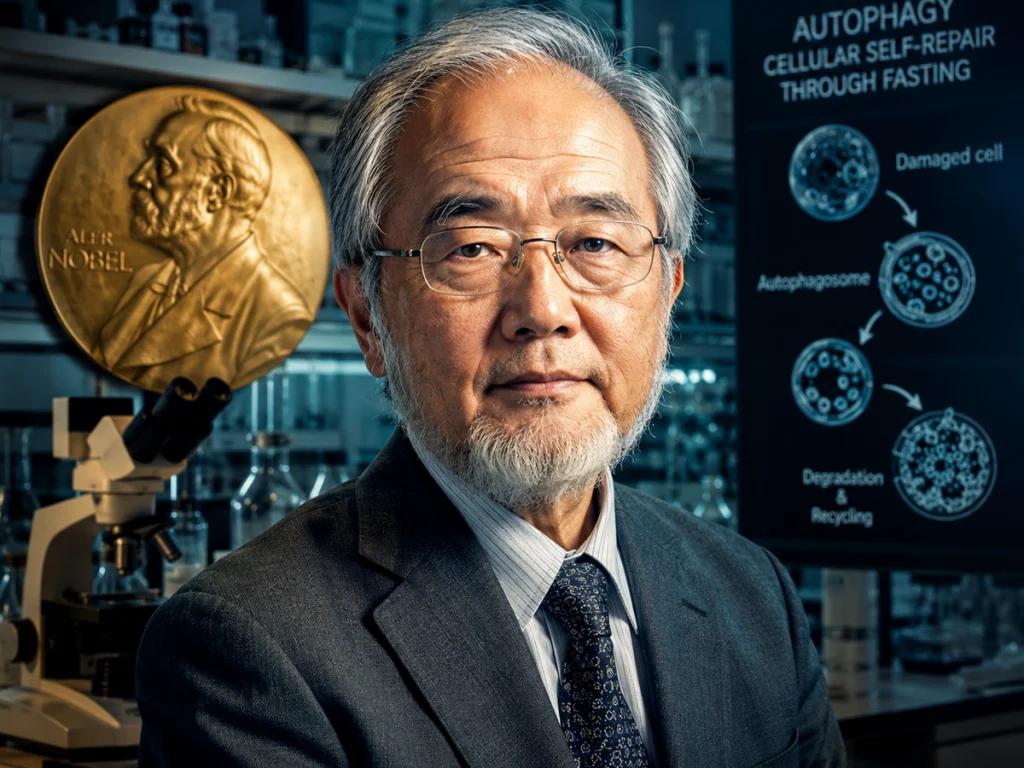
In 2016, a quiet Japanese biologist named Yoshinori Ohsumi won the Nobel Prize in Physiology or Medicine for uncovering one of the most overlooked processes in human biology: the body’s own self-cleaning system.
For decades, Ohsumi worked in a small lab studying baker’s yeast, a subject most of his peers considered unglamorous. Nobody wanted to fund it. But in the early 1990s, working as an assistant professor at the University of Tokyo, he set out to answer a simple question: does a cell have a way to break down and recycle its own damaged parts?
What Ohsumi Actually Discovered
The process is called autophagy, from the Greek words auto (“self”) and phagein (“to eat”). It literally means “self-eating.” Scientists had observed the phenomenon as far back as the 1960s, but almost nothing was known about how it worked or what triggered it.
Ohsumi changed that. He engineered yeast cells that lacked the enzymes needed to break down cellular waste, then starved them. Under a microscope, he watched something remarkable happen: the deprived cells began forming sack-like structures that engulfed damaged proteins and worn-out cell parts, hauling them off for recycling. In 1993, he identified 15 genes essential to this process, opening an entirely new field of biology.
“For his discoveries of mechanisms for autophagy” – the official citation from the Nobel Committee.
Why Starvation Triggers Repair
Here is the part that matters outside the lab. When a cell faces a shortage of food, it has two options: shut down, or get resourceful. Autophagy is the resourceful option. The cell strips damaged components for spare parts, burns broken proteins for fuel, and reassembles stronger structures from the wreckage.
This is not a fringe theory. It is the mechanism a Nobel Prize was built on.
Later research extended Ohsumi’s work well beyond yeast, showing that the same recycling machinery operates in human cells. Autophagy has since been linked to the body’s defenses against cancer, neurodegeneration, and cellular aging, and disruptions in the process have been tied to a range of diseases.
Why Modern Eating Habits Shut It Down
The catch is that autophagy does not run constantly. It switches on under stress, specifically the stress of not eating. Constant grazing, three meals a day plus snacks, keeps insulin elevated almost around the clock. Elevated insulin signals abundance to the body, and abundance gives cells no reason to start breaking things down for spare parts.
In other words, a full stomach and a body deep in repair mode are, for the most part, mutually exclusive.
Researchers studying fasting windows of roughly 16 to 24 hours have found measurable increases in autophagic activity, along with reductions in inflammation markers and clearance of damaged mitochondria. What the diet industry once dismissed as “starvation mode” turns out to describe a process the Nobel committee recognized as fundamental cellular renewal.
The Business Built Around a Free Process
None of this is complicated or expensive. Autophagy does not require a prescription, a subscription, or a shopping cart. Yet a sprawling supplement industry has built products marketed around “activating autophagy,” often for prices that add up to hundreds of dollars a year, promising an outcome that time without food already provides.
Ohsumi’s research never produced a blockbuster drug. What it produced was proof that the body already knows how to solve many of its own problems, given the chance to do so. Chronic eating, without breaks, prevents chronic healing. The repair work happens in the silence between meals. Most people, busy with breakfast, lunch, dinner, and everything in between, never give their body that silence.