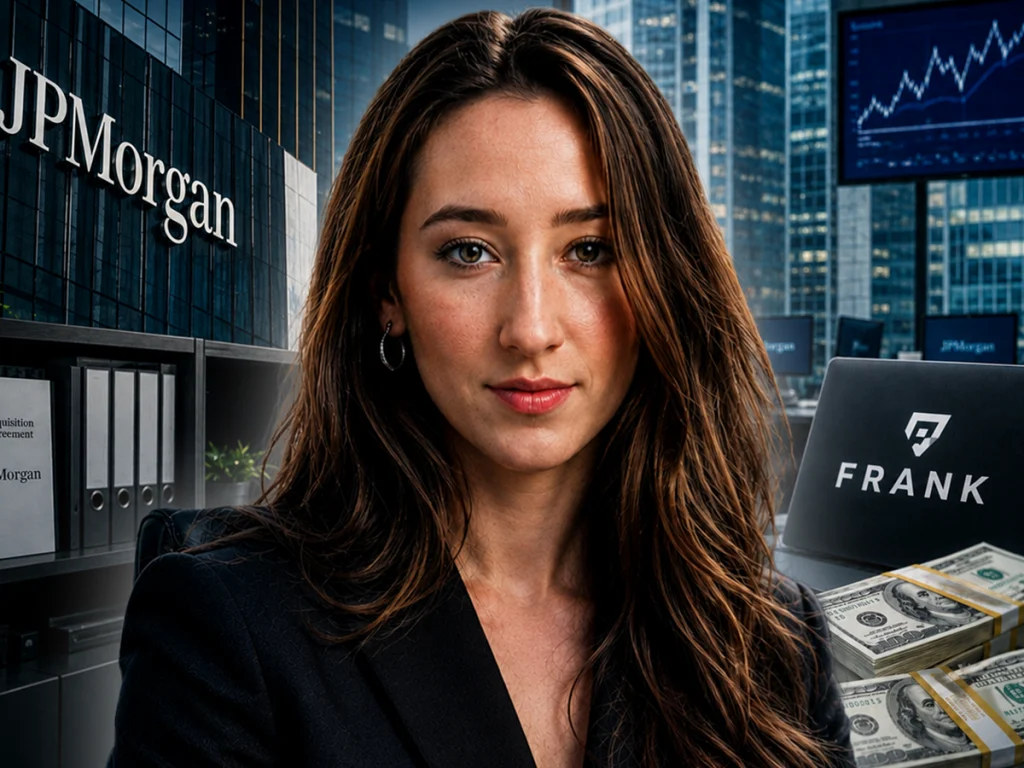
In 2017, a 24-year-old Wharton graduate named Charlie Javice founded Frank, a platform designed to simplify the notoriously painful process of filling out the FAFSA, the federal form students use to apply for financial aid. It was a real problem with a real solution, and for a while, it worked. Frank grew, investors backed it, and Javice landed on Forbes’ 30 Under 30 list. By 2021, she had bigger ambitions: selling the company to one of the largest banks in the world.
A Deal Built on a Number That Didn’t Exist
JPMorgan Chase wanted in on the fintech boom sweeping Wall Street. Concerned about competition from tech giants, CEO Jamie Dimon’s bank went on an acquisition spree, and Frank looked like an easy win, a startup with millions of student users the bank could market its products to. In September 2021, JPMorgan announced it was acquiring Frank for $175 million, believing the platform served more than 4 million students across 6,000 institutions nationwide.
There was just one problem. That number was fiction.
Javice had told the bank, repeatedly, that Frank had 4.25 million users. In reality, the company had roughly 300,000. When JPMorgan’s due diligence team asked to verify the data before closing the deal, Javice needed proof, fast, or the entire acquisition could collapse.
“We Don’t Want to End Up in Orange Jumpsuits”
According to court records, Javice first asked Frank’s director of engineering to generate a fake, “synthetic” dataset to pad the numbers. He raised concerns about the legality of the request. Her reported response: “We don’t want to end up in orange jumpsuits.” He refused anyway.
So Javice turned elsewhere. She reached out to Adam Kapelner, an associate professor of mathematics at Queens College, and told him she was in an “urgent pinch.” She asked him to build a list of over four million fake customer records using a real Frank list of fewer than 300,000 names as a starting point. When he asked why, she wouldn’t say.
Kapelner pulled an all-nighter to finish the job. Javice later asked him to strip any mention of “synthetic data” from his invoice, and paid him $18,000, well above his original $13,300 bill. In a text to her colleague and co-defendant, Olivier Amar, she wrote something that would later be read aloud in a Manhattan courtroom: “I found my genius.”
JPMorgan signed off on the acquisition without independently verifying a single user contact.
How the Fraud Unraveled
The fabricated database held for months. Then JPMorgan tried to use it. When the bank sent marketing emails to roughly 400,000 of Frank’s supposed customers, about 70% bounced back as undeliverable. Ghosts, it turned out, don’t check their inboxes.
JPMorgan launched an internal investigation and discovered the truth: the vast majority of Frank’s “users” had never existed. The bank had paid $175 million for a customer list that was, in large part, invented.
From Millions to a Prison Sentence
Javice was arrested in 2023 and indicted on four federal counts: securities fraud, wire fraud, bank fraud, and conspiracy. Her trial began in February 2025 and lasted six weeks. Prosecutor Micah Fergenson didn’t mince words, telling the jury that “JPMorgan didn’t get a functioning business, they acquired a crime scene.”
On March 28, 2025, Javice was convicted on all four counts. On September 29, 2025, Judge Alvin Hellerstein sentenced her to 85 months in federal prison, along with three years of supervised release. The court also ordered her to forfeit over $22 million in pay, stock, and bonuses, and to pay $287.5 million in restitution, jointly with Amar.
Addressing the court before sentencing, Javice apologized, saying she was “haunted” by how her failure had turned something meaningful into something infamous. The judge acknowledged her words as “moving” but was unmoved on the outcome. “I sentence people not because they’re bad,” he told her, “but because they do bad things.”
The Twist Nobody Expected
Here’s where the story takes an unusual turn. Under the terms of the acquisition, Javice technically became a JPMorgan employee. That contractual detail triggered a legal obligation: the bank was required to cover her defense costs, both criminal and civil. Those legal fees eventually topped $100 million, a bill JPMorgan was forced to pay for the employee who defrauded it.
Judge Hellerstein didn’t let the bank off easy either. He noted that JPMorgan had “a lot to blame themselves for” after skipping proper verification of Frank’s user data before closing a nine-figure deal. Still, he was clear about where the punishment belonged: “I’m punishing her conduct and not JPMorgan’s stupidity.”
A Cautionary Tale for Both Sides
Javice’s case became one of the most closely watched startup fraud trials since Elizabeth Holmes and Theranos. Her lawyers tried to draw a distinction between the two cases, arguing Frank was a real, functioning product, unlike Theranos. Prosecutors disagreed, painting Javice’s actions as calculated and greed-driven, pointing to the $29 million payday she personally collected from the sale.
What makes the Frank saga stand out isn’t just the scale of the deception. It’s the fact that one of the most sophisticated financial institutions in the world handed over $175 million based on a spreadsheet nobody bothered to check. Sometimes the biggest fraud isn’t only the work of the con artist. It’s the willingness of a buyer to believe a number that was simply too good to question.