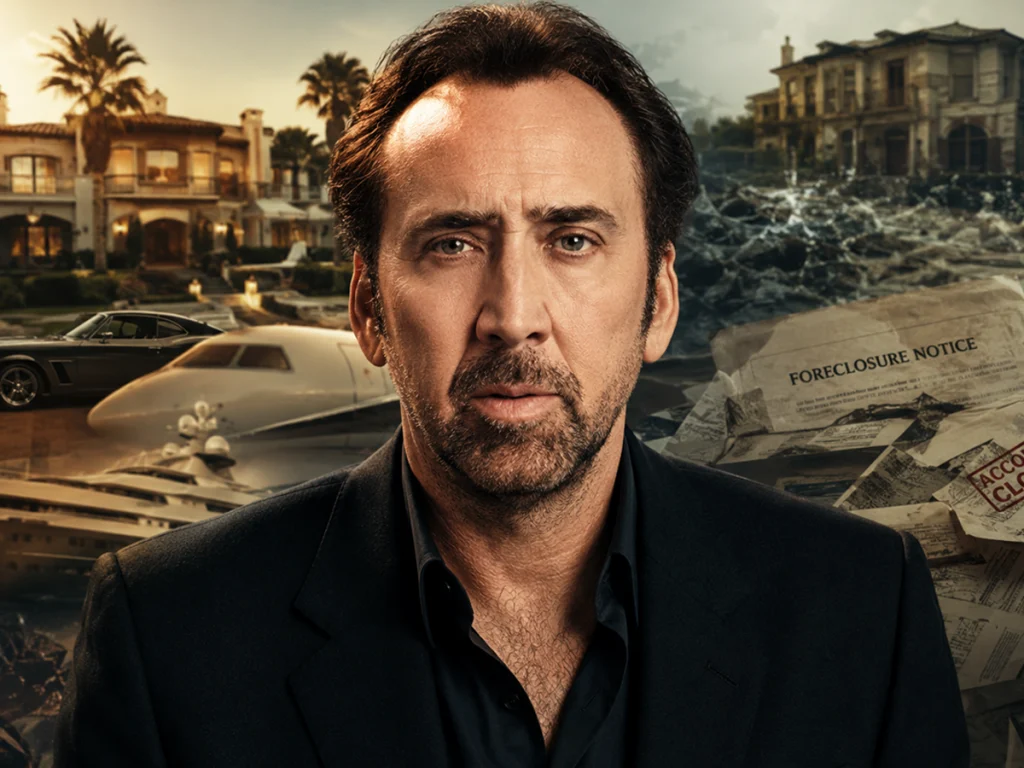
Nicolas Cage was, for a stretch of the late 1990s and 2000s, one of the highest-paid actors alive. The Rock, Con Air, and the National Treasure franchise turned him into a box-office fixture, and his fee per film climbed into the eight figures. By the time the financial crisis hit in 2008, headlines were calling him one of Hollywood’s biggest earners of the decade.
The Collapse Everyone Remembers
Then, in 2009, Cage filed for what amounted to a financial collapse. He owed the IRS more than $6 million in back taxes, and reports at the time pegged his total losses somewhere near $150 million. The story that followed became a punchline: a man who reportedly bought a private island, a haunted mansion, shrunken pygmy heads, and even a stolen dinosaur skull he had to return to Mongolia.
That version of the story isn’t wrong. Cage really did spend on an almost cartoonish scale. But it also isn’t the whole story, and the part that got left out says a lot more about him than the auction receipts do.
The Part That Got Left Out
Long before the bankruptcy headlines, Cage had a documented history of giving that rarely made the front page. He won a United Nations humanitarian award for his work supporting the rehabilitation of former child soldiers. After Hurricane Katrina in 2005, he donated $1 million to relief and rebuilding efforts in New Orleans, a city he’d adopted as a second home. He has supported causes ranging from homelessness charities to cancer research, largely without turning the giving into a press event.
One of the more telling stories involves the 2012 film Joe. Cage worked closely with Gary Poulter, a homeless man cast in a major role after being discovered on the street. Cage reportedly bonded with him over lunch before filming began, and by all accounts treated him not as a curiosity but as a colleague. Poulter was diagnosed with terminal cancer shortly after the film wrapped – a story that shows just how tangled Cage’s world of fame and quiet generosity has always been.
“I just met your brother. He has the best sense of humor,” Cage reportedly told Poulter’s sister after their first meeting – a small, human detail from a relationship that had nothing to do with box office numbers.
Stories about Cage anonymously covering medical bills for fans, or quietly helping people he barely knew, have circulated for years across fan communities and entertainment outlets. Not every detail in every version can be independently verified, but the pattern behind them is consistent with a documented decade of humanitarian awards, unpublicized donations, and a reputation among people who’ve worked with him for genuine, low-key generosity.
Two Clocks, Two Currencies
Here’s the part that rarely gets said out loud: money and meaning don’t move on the same clock. Cage’s fortune vanished in headlines within a year. Whatever good his money did for the people he quietly helped never showed up in a bankruptcy filing, and never will.
By 2011, Cage was working again, taking on films at a punishing pace specifically to pay down his debt. He never publicly complained about the loss, and never asked for sympathy over the spending sprees that made him a tabloid fixture. In interviews, he’s largely brushed off the bankruptcy narrative, treating it as the price of a life lived without much restraint.
The Story in 2026
In 2026, the narrative around Cage has shifted again. Critical reappraisals of films like Pig and a string of acclaimed later-career performances have turned “the actor who went broke” into “the actor who never stopped working.” The money story still gets repeated. The quieter one rarely does.
Fortunes, even ones as large as Cage’s, are built to be spent, lost, and rebuilt. That’s the nature of money: it circulates. What doesn’t circulate the same way is the kind of help that never asked to be noticed in the first place.