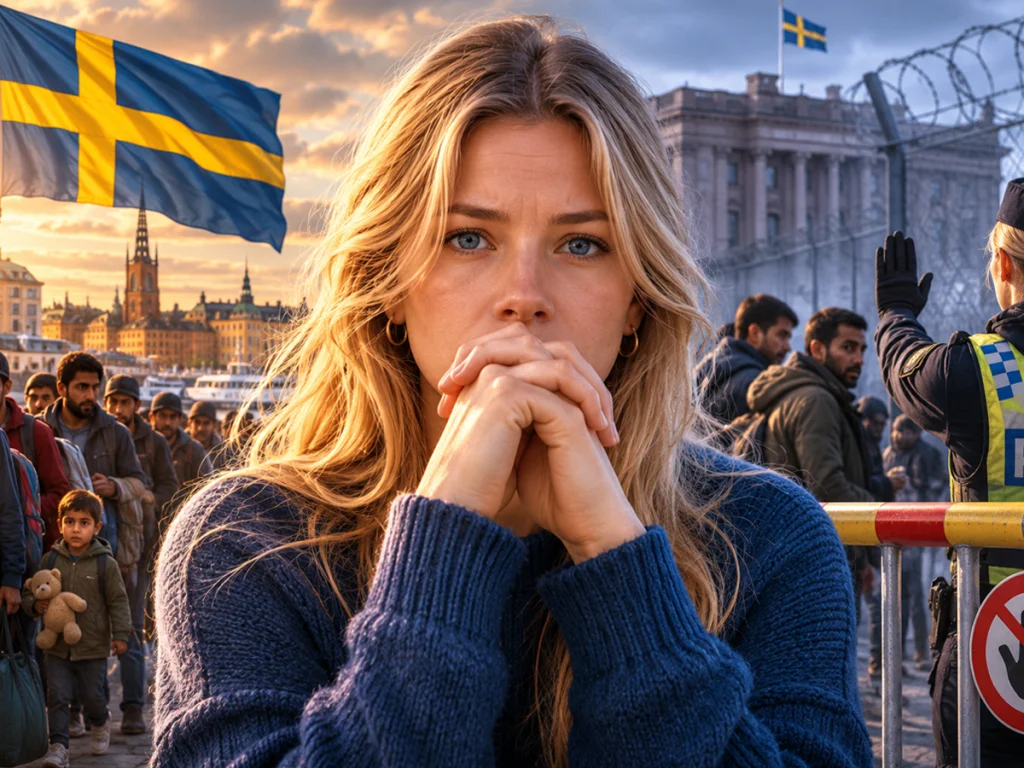
In 2015, Sweden opened its doors wider than any nation in Europe. By 2026, it had built one of the most restrictive migration systems on the continent. This is the story of how a single decade rewrote a country’s identity.
A Nation Defines Itself by Compassion
When Europe’s refugee crisis peaked in 2015, Sweden didn’t hesitate. The country took in roughly 160,000 asylum seekers in a single year, the highest number per capita anywhere in the EU. Politicians framed it as moral leadership. Ordinary citizens opened their homes to strangers. For a moment, Sweden looked like proof that a wealthy democracy could absorb a humanitarian crisis without losing itself.
That moment didn’t last.
When Capacity Runs Out
Behind the applause, the system was buckling. Housing markets seized up in cities that had no plan for the sudden demand. Small towns absorbed newcomers they lacked the infrastructure to support. Integration slowed, unemployment among foreign-born residents stayed persistently high, and language barriers hardened rather than faded with time.
The strain showed up in daily life. Some neighborhoods developed into what Swedish media began calling “parallel societies” – areas where Swedish was rarely spoken and welfare dependence deepened resentment between communities. Gang violence rose alongside it. Reporting from outlets including the Daily Express noted Sweden posting the highest rate of gun-related deaths per capita in the EU in recent years.
The Political Snap
Public patience didn’t erode gradually – it broke. In the 2022 election, the once-fringe Sweden Democrats surged to roughly 20.5% of the vote, becoming the second-largest party in parliament. They didn’t join the government outright, but they became its indispensable partner, propping up Ulf Kristersson’s coalition from outside. Their price wasn’t cabinet seats. It was policy control over migration.
What followed was described by Migration Minister Johan Forssell as nothing less than a “paradigm shift.” As he put it during a 2024 press conference announcing the new return incentives:
“We are in the midst of a paradigm shift in our migration policy.”
Rewriting the Rules, One Law at a Time
The reforms arrived in waves rather than a single overhaul, but their direction was consistent: make Sweden a harder place to arrive in, and an easier place to leave.
- Temporary status became the default. Permanent residence permits grew far harder to obtain, replacing the more generous standards of the 2015 era.
- Family reunification tightened. Requirements for bringing relatives to Sweden grew stricter across multiple rounds of legislation.
- “Track change” was abolished. As of April 1, 2025, rejected asylum seekers could no longer apply for work permits from inside Sweden, closing a pathway that had let thousands stay legally after a denied claim.
- Income requirements rose. Labour immigration rules were adjusted so wages must reach roughly 90% of Sweden’s median, according to a 2026 agreement between the government and the Sweden Democrats.
- Enforcement expanded. New rules taking effect later in 2026 broaden the list of crimes that trigger deportation and lengthen re-entry bans.
Paying People to Leave
Perhaps the most striking shift came in the government’s approach to those already in Sweden. Since 1984, the country had offered a modest repatriation grant for migrants willing to return home voluntarily – originally just 10,000 kronor per adult, capped at 40,000 kronor per family. Almost nobody used it. Officials noted that only a handful of people accepted the grant in recent years combined.
Starting January 1, 2026, that figure jumped to SEK 350,000 per adult – about $34,000 – with families eligible for up to 600,000 kronor. The payment is staggered: a fifth on approval, 40% on arrival in the destination country, and the remainder after 15 months. Migration Agency Director-General Maria Mindhammar described the goal in official terms, saying the support “gives people more control over their choice to move.”
Critics read it differently: a wealthy country quietly paying people to stop being its problem.
The Numbers Tell the Rest
The scale of the reversal shows up starkly in the data. Asylum approvals collapsed to roughly 6,250 people by 2024, a drop of more than 90% from the 2015 peak. For the first time in half a century, net migration turned negative – more people left Sweden than arrived. By 2025, asylum applications had fallen to their lowest level in three decades, with Iraqi, Somali, and Syrian communities shrinking as members returned home or moved elsewhere.
A Ripple Across Europe
Sweden’s pivot didn’t happen in isolation. Denmark tightened its own already-strict rules further. Germany followed with new restrictions of its own. The Netherlands shifted its migration policy in a similarly hard direction. But few, if any, European nations reversed course as completely or as quickly as Sweden did – going from the continent’s most open asylum policy to one of its most restrictive within a single decade, under both left- and right-leaning governments.
What Sweden’s Decade Proves
Sweden’s experience captures an uncomfortable truth that few politicians want to say aloud: compassion without capacity eventually collapses under its own weight. Open borders and closed borders are both deliberate political choices, and both carry consequences that take years, sometimes a generation, to fully understand. Sweden opened its doors to the world’s praise. It closed them to the world’s shock. The voters didn’t change. The country did.