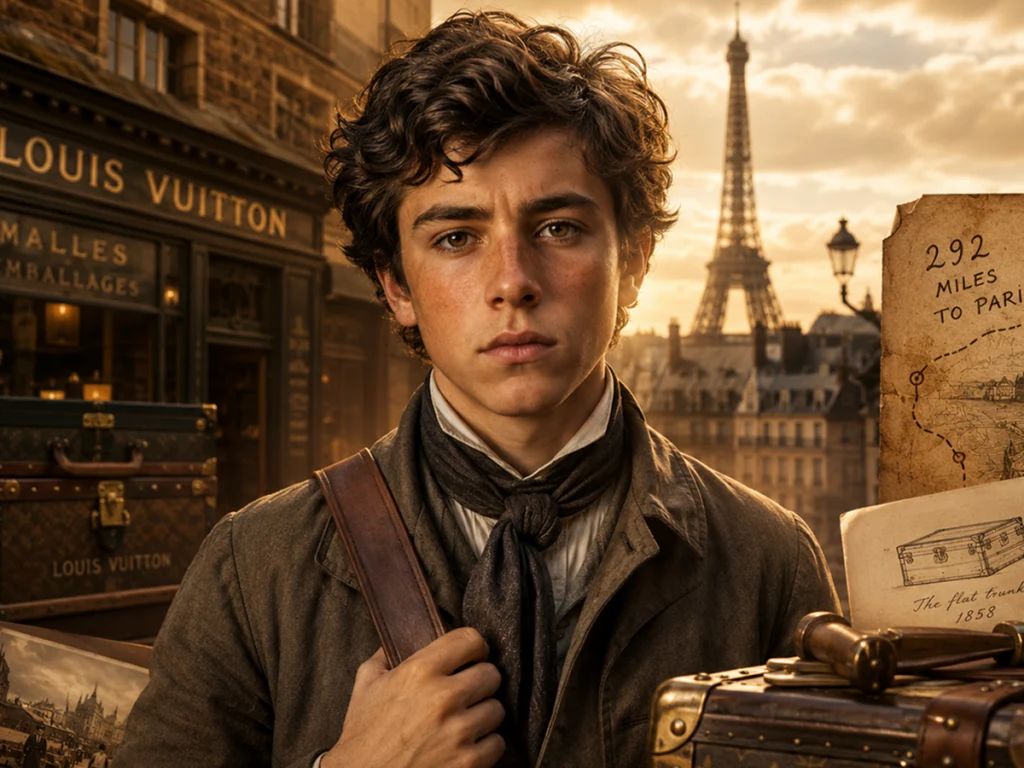
In 1835, a thirteen-year-old boy walked out of a small village in eastern France with nothing but the clothes on his back. He could not read. He had no money and no plan beyond one destination: Paris. Nobody watching him leave could have guessed that this runaway would eventually build the most valuable luxury brand on Earth, one now worth an estimated $129 billion in 2026.
His name was Louis Vuitton.
A Childhood Cut Short
Louis Vuitton was born on August 4, 1821, in Anchay, a remote hamlet tucked into the wooded Jura mountains of eastern France. His family had worked the land and the mills there for generations. His father, Xavier, was a farmer and joiner. His mother, Coronne Gaillard, was a milliner who taught him an early appreciation for careful, hands-on craft.
That stability collapsed when Louis was only ten. His mother died, and his father quickly remarried a woman Louis found strict and unbearable. Provincial life in Anchay offered him little, and his relationship with his stepmother offered him even less. By thirteen, he had made up his mind to leave for good.
The Walk That Changed Everything
In the spring of 1835, Vuitton set out on foot, alone, for Paris. The journey covered roughly 292 miles and took him nearly two years to complete. He slept in forests. He took whatever work he could find along the way, from day labor to lumberjacking, just to keep eating.
He finally reached Paris in 1837, arriving in the middle of the Industrial Revolution. He was sixteen, illiterate, and utterly without connections. What he did have was a set of woodworking skills inherited from his family, and an unusual amount of resilience for someone so young.
Learning a Dying Craft at the Right Moment
Vuitton found an apprenticeship with Romain Maréchal, a respected layetier, a box-maker and packer who built custom trunks and cases for wealthy travelers. In the 1830s, this was considered a genuinely respectable trade. Every trunk was handmade to fit its owner’s belongings, built to survive the punishment of horse-drawn carriages and rough sea crossings.
Vuitton rose through the workshop quickly. Within a few years, he had built a reputation among Paris’s fashionable elite as one of the city’s finest craftsmen. In 1852, that reputation reached the top of French society: he was appointed personal trunk-maker to Empress Eugénie, wife of Napoleon III. It was a career-defining connection, one that would soon deliver him an entire clientele of nobility.
Spotting the Flaw Everyone Else Ignored
Here is the detail that made Vuitton more than a skilled tradesman. While the world of transportation was changing fast, the world of luggage had not caught up. Trunks were still built with rounded, dome-shaped tops, designed specifically to shed rainwater during carriage travel.
But by the 1850s, carriages were being replaced by trains and steamships. Cargo was now stacked, packed tightly, and shipped in bulk. Round-topped trunks did none of this well. They wasted space. They slid. They tipped over. It was an obvious mismatch, but almost nobody in the industry had bothered to fix it.
Vuitton had.
Building His Own House
In 1854, after marrying Clemence-Emilie Parriaux, Vuitton left Maréchal’s workshop and opened his own business at 4 Rue Neuve-des-Capucines, steps from the Place Vendôme. The sign above his door read a version of: “Securely packs the most fragile objects.”
Four years later, in 1858, he unveiled his solution: a rectangular, flat-topped trunk built from poplar wood and covered in a lightweight, waterproof grey canvas instead of heavy leather. The design stacked perfectly. It was lighter than anything on the market. Most historians consider this trunk the true birth of modern luggage.
Wealthy travelers adopted it almost immediately, and orders multiplied. Vuitton’s client list soon stretched across European nobility, including a commission for Ottoman Sultan Abdülhamid II.
A Brand Worth Protecting
Success invited imitation, and by the 1880s, counterfeit “Vuitton” trunks were spreading across Europe. In 1888, the company introduced the Damier canvas, stamped with the words “Marque L. Vuitton Déposée”, a registered trademark meant to shut counterfeiters out.
Louis Vuitton died in 1892, leaving the company to his son, Georges Vuitton. Four years later, in 1896, Georges introduced the now-iconic LV monogram canvas, blending geometric floral motifs with his father’s initials. It remains one of the most recognized, and most counterfeited, patterns in the world.
From a Dirt Road to a Global Empire
Today, Louis Vuitton anchors a luxury empire valued at roughly $129 billion, making it the most valuable luxury brand on the planet. Its stores sit in the world’s biggest cities, and its monogrammed trunks now double as design icons rather than mere baggage.
None of it started with prestige, capital, or education. It started with a boy who noticed something small: the world had changed, and nobody had bothered to change the luggage with it.