Elon Musk has a habit of dropping civilizational grenades in casual conversation. He did it again recently at a summit – not in a peer-reviewed paper, not in a formal press release – just in passing, the way someone might mention the weather.
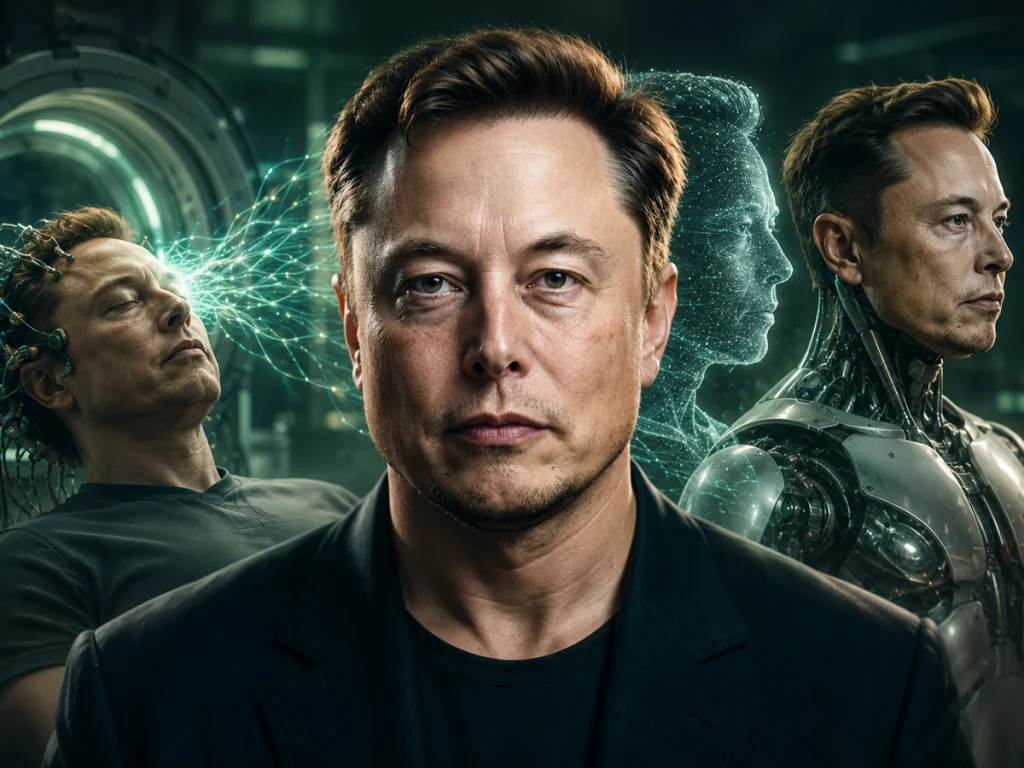
“You’re going to have a full brain interface that is basically a form of immortality. Your mental state is saved. You’re backed up on a hard drive. You can always restore that brain state into a biological body – or maybe a robot, or something.”
Most headlines covered Neuralink as a medical device story. A chip that helps paralyzed patients control a computer with their thoughts. Twelve patients with severe paralysis are currently using the implants, including 29-year-old quadriplegic Noland Arbaugh, who uses it to play video games, browse the internet, and play chess – all by thought alone. That part is real, measurable, and genuinely impressive. Technology OrgFierce Biotech
But Musk is not talking about cursors. He is talking about the oldest problem in human history.
The Tool Everyone Is Watching – And What They’re Missing
“The human brain has a lot of constraints,” Musk said. “Ultimately, you will have a whole brain interface that is a sort of form of immortality in that if your brain state is stored, you’re kind of backed up on a hard drive.” He added that the technology is “many years in the future, but we’re not breaking any laws of physics. This is probably something that will happen.” TheStreet
Neuralink is already moving toward high-volume production and an almost entirely automated surgical procedure in 2026. The N1 implant now includes 1,024 electrodes spread across 64 threads, implanted in 12 patients by September 2026. The hardware is scaling. The surgery is becoming routine. The ambition, however, is anything but routine. Fierce BiotechThe Bridge Chronicle
The technology could eventually allow humans to upload themselves into new units if their biological selves die – essentially achieving immortality. Musk believes that by merging with AI, humans will be able to keep pace with rapid technological advancement and compete against AI itself. Yahoo Finance
The Oldest Contract in Human History
Here is what nobody in the technology press is properly sitting with. Every structure humans have ever built – every legal system, every religion, every economic model, every philosophy – rests on a single assumption so basic it is never spoken aloud: people end.
Inheritance law exists because wealth outlives owners. Insurance exists because risk is finite. Retirement exists because productivity has a biological expiration date. The entire architecture of civilization was designed around a species that runs out of time. Remove that constraint and the blueprints stop making sense.
Musk connected Neuralink’s long game directly to artificial intelligence: “We’re moving so fast toward digital superintelligence that maybe it solves the problem for us. Meanwhile we keep going with our meat computers.” Meat computers. Not a dark joke – the exact technical specification of what a human brain is, from an engineering perspective.
Who Is Actually Funding This Race – And Why
The public narrative around AI investment focuses on productivity, automation, and economic efficiency. That framing is almost certainly incomplete. The real driver, the one that never makes the press release, is biological urgency. Every founder writing eight-figure checks into this space is a human being aware of their own expiration date. Building a clock that beats your own biology is a different motivation than building a better search engine.
This is not a conspiracy. It is simple, transparent self-interest – the most ancient kind. The difference between now and every previous era is that for the first time, the people with the motivation also have the capital, the compute, and a credible technical path.
The Question Nobody Wants to Answer
Every risk you ever took, every deadline you ever met, every moment that actually forced you to choose – it was powered, somewhere underneath the decision, by the awareness that your time was limited. Mortality was never just the thing that killed you. It was the pressure that made you move.
The builders want to eliminate that pressure entirely. And before we celebrate the engineering, someone needs to ask the harder question: what do we put in place of the only deadline the human species has ever truly respected?
That answer does not exist yet. And the people racing toward the finish line are not stopping to write it.