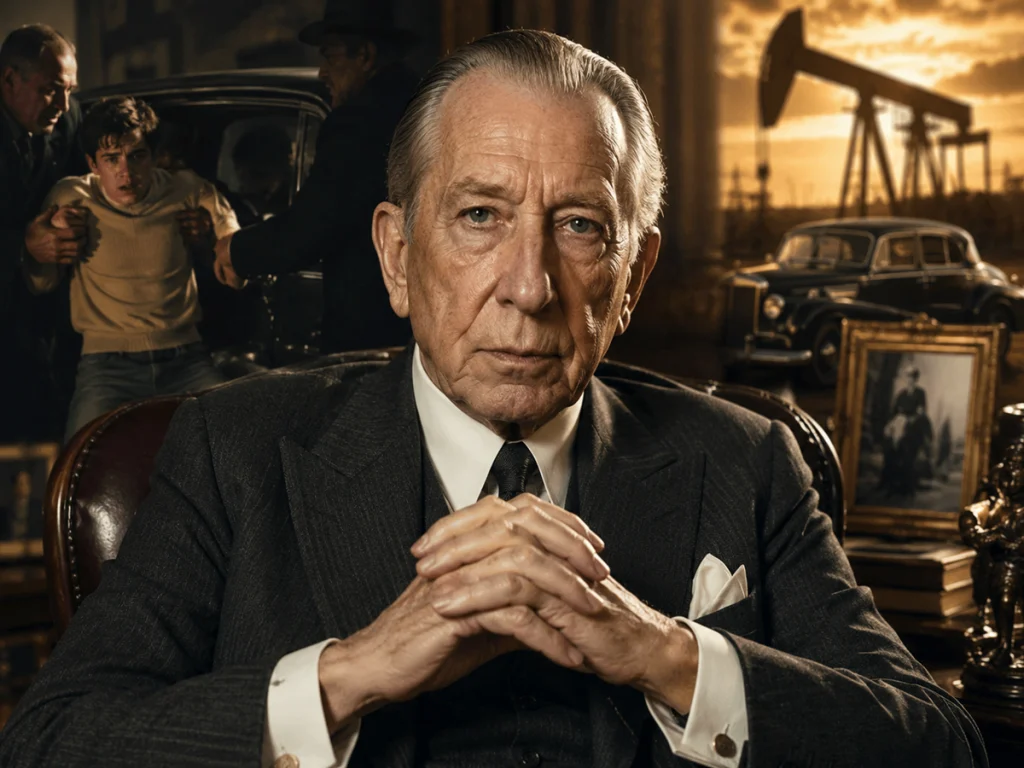
J. Paul Getty was born in 1892 in Minneapolis, the son of an oil businessman, and he had no intention of staying in his father’s shadow. By 23, he had struck oil in Oklahoma on his own and become a millionaire. He spent the next two years chasing parties and entertainment across the country. Then, almost as quickly as he’d left, he got bored and came back to business for good.
His biggest gamble came in 1949, when he paid $9.5 million in cash for a 60-year oil concession in Saudi Arabia. Other investors called the land worthless desert and walked away. For four years, the wells produced nothing but sand and silence. Then, in 1953, oil finally erupted from the ground, and that single bet reshaped the rest of his life.
Getty had a habit of buying exactly when everyone else was selling. By the late 1920s, he had already multiplied his fortune fivefold through sharp, early moves. When the Great Depression crushed businesses across America, he went shopping instead of hiding. He picked up failing oil assets for a fraction of their worth, turning “crisis for most people”into pure opportunity for himself.
By the late 1950s, Getty was widely considered the richest man alive. By 1968, his net worth was estimated between $2 and $4 billion, a figure so large it barely made sense to the public at the time. Adjusted for 2026, that fortune would rival $20 to $30 billion today. He eventually moved his empire’s headquarters to England, where he lived out the rest of his years.
None of that money bought him warmth at home. Getty married five times and never made a single marriage last. He became almost as famous for his frugality as for his fortune. Inside his own English castle, he reportedly installed a payphone so guests couldn’t run up his phone bill for free. He summed up his own philosophy in one blunt sentence: “Lasting relationships are only possible if you’re broke.”
He built an art empire right alongside his oil empire, and the two were never truly separate. Getty collected paintings and antiquities aggressively, eventually founding the museum that still carries his name today. But art wasn’t only a passion project for him. It preserved capital, cut his tax exposure, and polished his public image, all at the same time.
Then came the test that would define his legacy far more than any oil field ever could. In July 1973, his 16-year-old grandson, John Paul Getty III, vanished from Rome’s Piazza Farnese in the early hours of the morning. Kidnappers linked to the ‘Ndrangheta, a mafia organization from Calabria, demanded roughly $17 million for his safe return. Getty’s answer stunned even the journalists already covering the case.
He didn’t hesitate, and he didn’t negotiate. He refused outright, telling the press: “I have 14 other grandchildren, and if I pay one penny now, then I will have 14 kidnapped grandchildren.” He genuinely suspected the whole kidnapping was a hoax, staged by a grandson who had been living a bohemian life in Rome after getting expelled from private school.
Months dragged on without any resolution, and the kidnappers grew impatient and cruel. In November 1973, a package arrived at a Roman newspaper containing a lock of the boy’s hair and his severed right ear. The note beside it read: “This is Paul’s ear. If we don’t get some money within 10 days, then the other ear will arrive.” Front pages across Italy carried the image within days.
Even that horror didn’t make Getty simply write a check. Lawyers haggled the ransom down to roughly $3 million total. Getty agreed to personally cover $2.2 million, the maximum sum his own accountants said was tax-deductible. His son, John Paul Getty Jr., paid the rest, after borrowing it from his father at 4% interest.
On December 15, 1973, five months after his abduction, the boy was finally released and found alone at a gas station in the Italian countryside. Later, on his mother’s suggestion, he called his grandfather to thank him for paying. According to multiple accounts, Getty refused to come to the phone.
The physical wound healed eventually, through reconstructive surgery years later. The psychological one never did. Getty III developed severe alcohol and drug addiction in the years that followed his release. In 1981, a drug-induced stroke left him paralyzed, nearly blind, and unable to speak, for the rest of his life. His mother cared for him until his death in 2011, at age 54, after nearly three decades of disability.
J. Paul Getty left behind an oil empire that reshaped global energy markets, and a museum that still draws millions of visitors every year. He also left behind a family that never fully recovered from the price of his caution. Extreme wealth bought him control over every dollar he ever earned, but it never bought him peace, and it never bought his grandson back the years he lost.