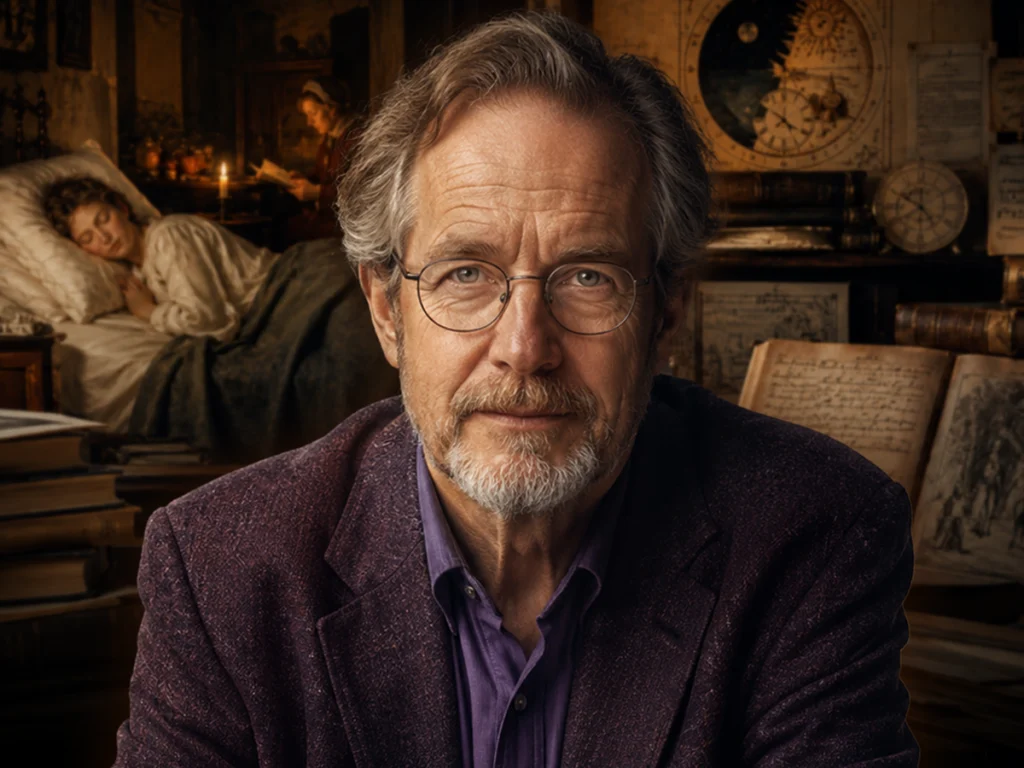
For most of human history, nobody slept for eight hours straight. They slept twice.
A historian at Virginia Tech spent over a decade proving it, and what he found rewrites almost everything we assume about “normal” sleep.
A Pattern Hidden in Plain Sight
Historian A. Roger Ekirch originally believed, like most people, that eight hours of unbroken rest was a biological constant that never changed across time or place. Then he started digging through diaries, court records, and medical texts from preindustrial Europe, and he found the first evidence that many people used to sleep in two segments, a first sleep and a second sleep, separated by a stretch of quiet wakefulness in the middle of the night.
He called this discovery the moment he uncovered “a pattern of sleep unknown to the modern world.”
His 2005 book, At Day’s Close: Night in Times Past, documented more than 500 references to this segmented sleep pattern pulled from diaries, medical books, court records, and literature. He didn’t stop there. Ekirch has since found more than 2,000 references across a dozen languages, tracing the pattern as far back as ancient Greece.
What People Actually Did in the Middle of the Night
The gap between the two sleeps wasn’t wasted time. According to Ekirch’s research, people used that window after midnight to do practically everything imaginable, rising to handle chores, check on sick children, or even raid a neighbor’s orchard, while others stayed in bed to pray or reflect on their dreams.
It wasn’t only a peasant habit either. A 16th-century French physician, Laurent Joubert, went as far as attributing the fertility of manual laborers to sex that happened during this window, claiming couples had more enjoyment and performed better “after the first sleep.”
References to this pattern show up far earlier than the Renaissance. Textual mentions trace back to Homer’s Odyssey, and Virgil’s Aeneid, written in the first century BC, describes the hour that marks the end of the first sleep.
The Slow Disappearance
Segmented sleep didn’t vanish overnight. Ekirch’s research shows the shift was gradual and tied directly to changes in how people lived after dark. References to a first and second sleep began disappearing during the late 17th century, a change Ekirch links to improvements in street lighting and a growing cultural obsession with efficiency.
The transition kept accelerating for another two hundred years. By the early 19th century, the first sleep had started expanding at the expense of the second, and the waking period between them was shrinking. By the end of that century, the “second sleep” was little more than rolling over for an extra ten minutes.
Artificial light didn’t just let people stay up later. It restructured what nighttime was for. Darkness stopped being a boundary and became just another set of hours to fill with work and productivity.
Is There Science Behind It?
The story isn’t only historical folklore. In the 1990s, sleep researcher Thomas Wehr ran a clinical study at the National Institute of Mental Health, placing participants in extended periods of darkness with no artificial light, mimicking preindustrial winter nights. Without modern light exposure, their sleep spontaneously split into two distinct phases, echoing the exact pattern Ekirch had found buried in centuries-old diaries.
More recent fieldwork backs this up. A 2017 study in the American Journal of Human Biology looked at a small-scale agricultural community in Madagascar with no electricity, and researchers found a sleep pattern strikingly similar to the first sleep and second sleep structure Ekirch had already described.
Not everyone agrees the case is closed, though. A more recent reconsideration published in a peer-reviewed history journal argues that while Ekirch’s theory has been widely accepted by historians, literary scholars, and the general public over the past two decades, the scientific and anthropological evidence backing it is selective and limited. It’s a reminder that even compelling historical patterns deserve scrutiny, not blind acceptance.
Why This Matters for Your 3 AM Wake-Up
Here’s the part that actually changes how people think about their own nights. Waking up in the middle of the night isn’t automatically a disorder. For most of human history, it was the default.
Modern sleep medicine treats one continuous eight-hour block as the gold standard, and anything else gets filed under insomnia. But if segmented sleep was the norm for thousands of years before gas lamps and light bulbs, then a 2 AM wake-up isn’t proof that something is broken. It might just be an old, familiar rhythm resurfacing in a body that no longer has permission to use it.
That doesn’t mean everyone should abandon their alarm clock and split their sleep in half tomorrow. Modern life runs on synchronized schedules, jobs, school runs, and traffic, none of which bend for biphasic rest. But the anxiety that comes with lying awake at night might, for some people, be solved less by medication and more by simply knowing the pattern has ancient roots.
As one sleep psychologist put it, night waking may be “part of normal physiology,” and forcing the body into one unbroken block could, in some cases, do more harm than good.
The lesson isn’t that eight hours of sleep is a myth invented to sell mattresses. It’s that the human body has run on more than one rhythm throughout its history, and modern life only recently decided there was just one correct way to rest.