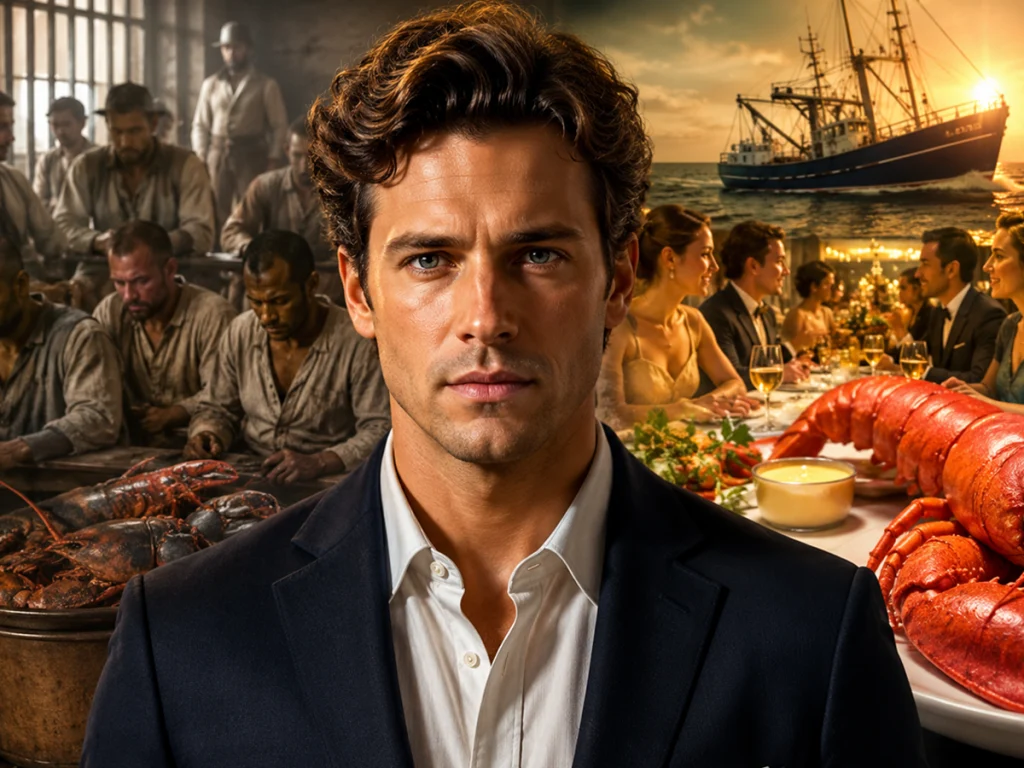
For 200 years, Americans fed lobster to prisoners as punishment. Today it costs $60 a plate and signals wealth. Nothing changed but the story. Here’s who rewrote it.
In colonial Massachusetts, lobsters didn’t arrive on silver platters. They arrived in piles. Waves dumped them along the shore by the thousands after storms. Farmers shoveled them into fields as fertilizer. Native Americans used them as fish bait. And when coastal landlords ran out of ideas for what to do with the surplus, they fed them to servants – so often, in fact, that some workers reportedly demanded lobster-free clauses before signing employment contracts.
The crustacean had a nickname: “the cockroach of the sea.” Eating it wasn’t a treat. It was a marker of poverty, a signal that you had no other options. Through the 19th century, lobsters regularly appeared on the plates of prisoners and enslaved people precisely because they cost nothing and caught themselves. The wealthy stayed away – partly for social reasons, partly because nobody had yet figured out how to cook them safely. Lobsters must be cooked alive to kill the bacteria that multiply quickly after death. Back then, no one knew this, which made them genuinely dangerous for anyone who didn’t live on the coast.
The product hadn’t changed. The audience had.
Then came the railroads.
In 1868, George Pullman introduced the first true dining car on the Chicago and Alton Railroad, naming it the Delmonico after New York’s most famous fine-dining restaurant. Competition among railroad companies exploded. By the mid-1880s, dedicated dining cars were a fixture on long-distance routes from Chicago to the West. Railroad operators hired the nation’s best chefs and used lavish menus as marketing tools – they wanted passengers to feel like they were dining in a first-class hotel, not riding a train.
Lobster appeared on those menus. And the passengers eating it had something the coastal population lacked: no context.
Inland diners from the Midwest and West had never seen lobsters pile up on a beach. They had no association with poverty, no cultural memory of the “cockroach of the sea.” They tasted something rich, visually dramatic, and rare – because in their world, it genuinely was. They paid accordingly. Scarcity followed perception, not the other way around.
By the 1850s, New York’s so-called “Lobster Palaces” were already serving the crustacean to high-society diners as a luxury item. The 1840s canning boom made lobster accessible nationwide but simultaneously drove severe overfishing – by the 1880s, canneries were processing half-pound lobsters where four- and five-pound specimens had once been considered small. Supply tightened. Prices climbed. The transformation was complete in under 50 years.
The lobster story is really a story about how value gets manufactured.
“Value is rarely objective. It is narrative plus distribution. Control the story and the supply, and you control perceived worth.”
The same mechanism runs through the entire luxury economy. De Beers restricted diamond supply for decades, creating artificial scarcity to drive artificial prestige. A Birkin bag costs a fraction of its retail price to produce. The markup is pure positioning – you pay for the story the brand tells, not the materials inside. Status becomes the actual product.
Ancient Spartans understood this instinctively. They distrusted excess not as a moral posture but as a strategic one – luxury weakens discipline and outsources identity. When self-worth depends on logos and price tags, consumption replaces character. The golden leash feels comfortable. And it scales globally.
Consumer systems are built to train aspiration through repetition. New phone. New drop. New season. The cycle runs itself. What feels like personal taste is often engineered conditioning – desire programmed through decades of calculated scarcity, aspirational framing, and status signaling.
Lobster is now the clearest example in culinary history of a complete value inversion. The same animal that marked poverty in 1800 marks wealth in 2026. Maine’s lobster catch has actually declined in recent years – from 132.6 million pounds in 2016 to 93.7 million pounds in 2023, partly due to climate change pushing lobsters into deeper, more expensive waters. Real scarcity has replaced the manufactured kind, but the prestige was established long before the supply tightened.
The taste never changed. The story did.
And whoever controls the story controls the price.