How the surrealist master turned his own name into a currency, and what his dinner-table genius can teach anyone who creates value for a living.
Salvador Dalí was one of the most deliberately eccentric figures of the twentieth century. He dressed for spectacle, spoke in riddles, and kept an ocelot as a pet. But behind the theatrical mustache and gold-tipped cane was a mind that understood something most artists — and most businesspeople — never grasp: your name, made extraordinary enough, becomes its own form of money.
The proof was on the back of a check.
The Dinner Ritual
Throughout his years in New York — where he wintered regularly at the St. Regis Hotel — Dalí cultivated a habit of gathering large groups of friends and admirers at the finest restaurants the city had to offer. The evenings were lavish by any measure: long tables, crystal glasses, rivers of wine, and dishes ordered without so much as a glance at the price. Bills could run to thousands of dollars in a single evening.
And then the check would arrive.
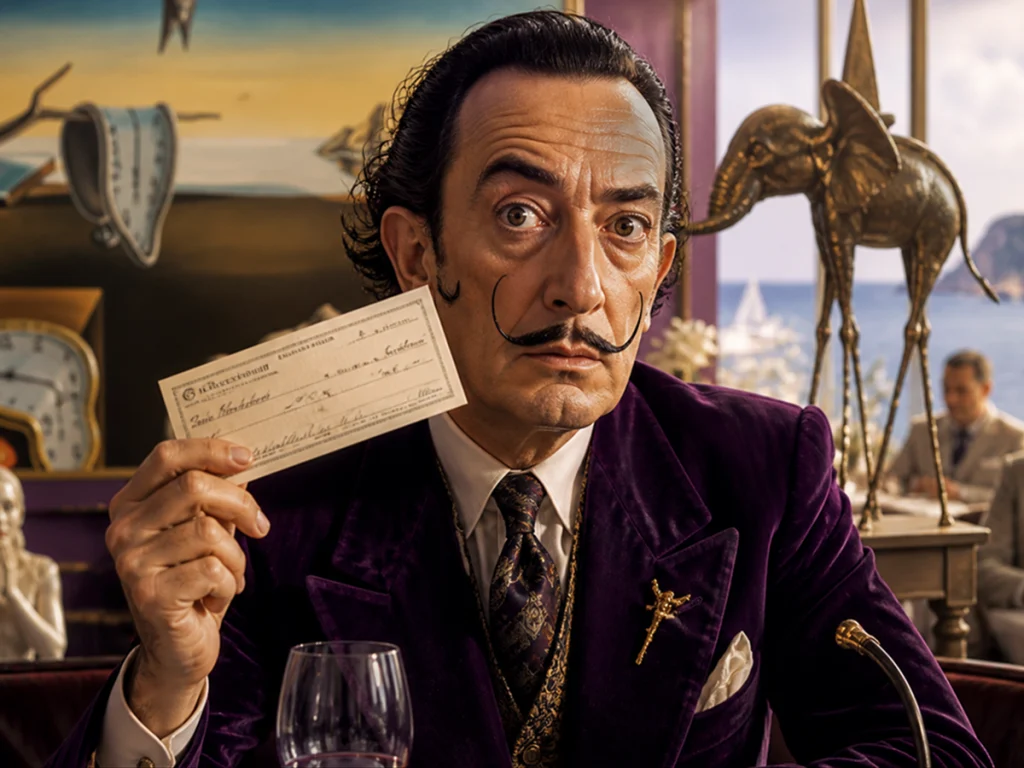
Dalí would reach for his checkbook with the practiced calm of a man who had done this many times before. He would fill out the check for the full amount — every cent, correctly totaled. Then, with the waiter watching, he would flip the check over and sketch a small drawing on the back. A surrealist image. An eye, a figure, a horse with elongated legs. Something unmistakably Dalí. He would sign it with his full signature and hand it over.
“He wagered, with astonishing bravado, that no restaurateur would ever attempt to cash a cheque bearing one of his sketches — and he was usually right.” — Apollo Magazine
The sketch transformed the check. What had been a financial obligation became a collector’s item. No one — not the waiter, not the manager, not the owner — would deposit a piece of original Dalí art into a bank account and watch it vanish as a line item. The check was kept. Framed, in some cases. And in many instances, when restaurants did eventually sell the sketches, they made considerably more than the cost of the meal.
The Logic Behind the Spectacle
It would be easy to read this as mere cleverness — a rich eccentric finding a loophole. But Dalí understood something far more structural. Value is not intrinsic to an object. It lives in the mind of the person holding it.
A check signed by an anonymous stranger is a piece of paper worth exactly its written amount. A check sketched on and signed by Salvador Dalí is a primary document of art history. The paper is identical. The ink weighs the same. But the perceived value — and therefore the real-world value — is entirely different. Dalí had not changed the check. He had changed the story around the check.
This is the mechanism behind every luxury brand, every signed jersey, every vintage bottle of wine. People are not buying the object. They are buying proximity to something they believe is exceptional. Dalí understood this intuitively and built his entire public persona around making himself undeniably, irreversibly exceptional.
The Name as Currency
The dinner trick only works if the name on the check carries weight. And Dalí spent decades making absolutely certain that it did. Every extravagance — the ocelot, the rhinoceros obsession, the press appearances, the surrealist stunts — was not random vanity. It was brand construction, executed with the discipline of someone who understood that fame is an asset that compounds over time.
By the time the check-sketching habit became a pattern, Dalí’s signature alone was worth more than most people earned in a year. He once reportedly said: “I’m not a clown. In their naivety, society sees no difference between the serious and the unserious.” He was not being self-deprecating. He was being precise. He had mastered the art of appearing unserious while executing, with absolute seriousness, a strategy that left him dining for free at the finest tables in New York.
What It Actually Teaches
The Dalí dinner story is often told as an amusing anecdote. It deserves to be treated as a case study. The lesson is not that eccentricity is a shortcut to wealth — it is not. The lesson is that perceived value and market value are the same thing, and that the person who shapes perception shapes the price.
Every time you pay more for a product because of the name on the label, someone applied Dalí’s logic to the transaction. Every time a signature makes an otherwise ordinary object collectible, that is the check trick in a different form. The art was never really the painting — or the sketch. The art was making people believe the sketch was priceless.
Dalí did not just eat for free. He demonstrated, one dinner at a time, that the name either carries weight — or it costs you nothing to ignore.