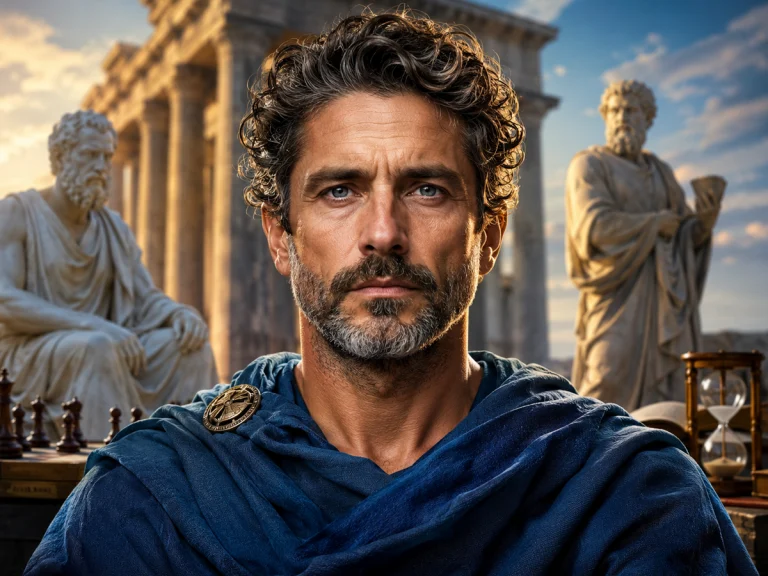
Ancient Greek warriors built their entire civilization on a hierarchy of love that modern culture has quietly abandoned. At the bottom sat eros – desire, passion, romantic obsession. The Greeks viewed it with genuine suspicion. Strong men were expected to master eros, not follow it. Reason governed the ideal warrior, and attachment that blurred judgment was considered a liability on the battlefield, not a virtue in the home.
Above eros stood something the Greeks valued far more highly: philia. This was deep male friendship built on loyalty and forged through shared hardship. Trust developed during training carried directly into war. The man standing shield to shield beside you mattered as much as, if not more than, anyone waiting back home.
Nowhere was this philosophy more extreme than in Sparta. Passion for women was treated as a form of mental weakness there. Male loyalty functioned as literal state infrastructure, woven into how the entire society operated. This wasn’t sentimentality. It was strategy.
The phalanx formation makes the logic obvious. Spartan military units depended entirely on trust between soldiers standing in tight lines, shields overlapping. One weak link exposed the whole formation. Collective strength reduced individual fear, and shared honor replaced personal ego. No soldier wanted to fail the man beside him, so brotherhood increased accountability more effectively than any law could have.
Sparta wasn’t alone in this belief. The Sacred Band of Thebes, one of ancient Greece’s most feared military units, trained soldiers in pairs of lovers and close companions specifically because commanders believed emotional bonds strengthened courage under pressure. The theory held for centuries: commitment amplifies resilience, and men fight harder for those they’re bonded to than for abstract causes alone.
Modern institutions run on the opposite logic. Individual ambition now outweighs collective loyalty almost everywhere. Professional networks have replaced the kind of deep alliances ancient warriors relied on, and utility has quietly replaced brotherhood as the currency of male relationships.
The numbers back this up starkly. According to research from the Survey Center on American Life, the share of American men reporting six or more close friends collapsed from 55% in 1990 to just 27% by 2021. Over the same period, men reporting zero close friends rose roughly fivefold. A 2025 Gallup poll found that 25% of American men aged 15 to 34 experience loneliness on a given day, making them, by that measure, the loneliest demographic in the Western world.
Researchers point to a familiar cluster of causes. “Third places” – the pubs, clubs, and community halls where male friendships once formed casually – have thinned out with little to replace them. Remote work stripped away the incidental daily contact that offices used to provide. Many men now route their entire emotional life through a single romantic partner, leaving no wider circle to fall back on if that relationship ends. Screens increasingly substitute for the calls and meetups that build real closeness.
The public health stakes are not abstract. The 2023 US Surgeon General advisory compared the health risks of chronic loneliness to smoking up to fifteen cigarettes a day, linking social disconnection to elevated risks of heart disease, stroke, and dementia. As the advisory put it:
“Our epidemic of loneliness and isolation has been an underappreciated public health crisis that has harmed individual and societal health.”
None of this means Sparta offers a template worth copying wholesale. Spartan society was rigid, militaristic, and built on structures modern readers would rightly reject. But the underlying insight is harder to dismiss. Ancient warriors didn’t build brotherhood for sentimental reasons. They built it because survival demanded it. Modern men lost the demand, and largely lost the bond along with it.
Comfort quietly removed the need for other men to survive day to day. What’s left is a generation of men who are rarely friendless on paper but increasingly have no one they actually talk to. The Spartans would likely call that a structural failure, not a matter of bad luck or personal shortcoming, and the data on rising isolation suggests they might have had a point.